The Defensible AI Stack: How Startup Founders Build Long-Term Moats in the Age of Commodity LLMs
A practical framework for assessing whether an AI product creates durable value through proprietary workflow knowledge, reliable evaluation, trusted integrations, and operating execution - not just access to a model API.
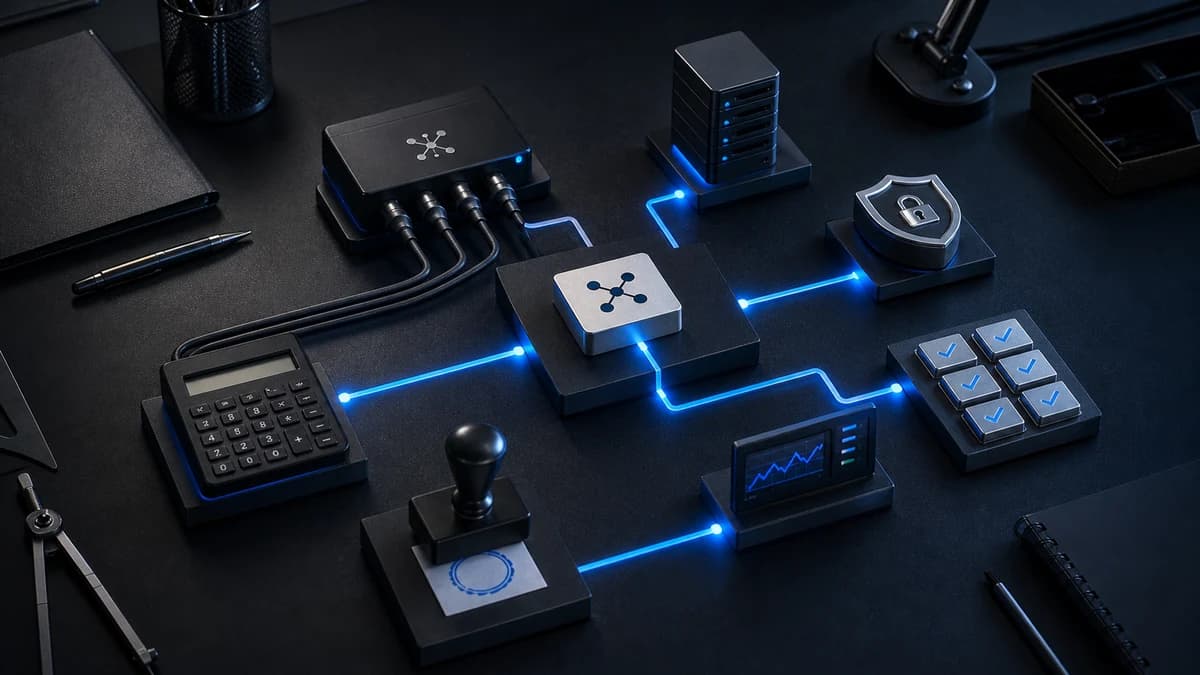
 Defensibility layers
Decision brief
The short answer
Model access rarely creates durable differentiation on its own. Defensibility is more likely to come from proprietary workflow integration, trusted data rights, outcome feedback, evaluation assets, and reliable execution that competitors cannot reproduce by changing a prompt.
Identify which product advantage improves as customers use the system.
Measure whether the advantage survives a model-provider change.
Verify that data rights and operating processes support the claimed advantage.
At a glance
What to carry into the decision
- Durable value usually sits in workflow integration, proprietary feedback, evaluation, and reliable execution.
- Keep model providers replaceable where the workload allows, but measure quality before changing routes.
- Treat permissions, observability, and recovery behavior as product capabilities, not infrastructure afterthoughts.
Key Takeaway
Access to a model API is available to many competitors. Durable product value may come from permissioned data workflows, evaluated task performance, integration into an important process, user trust, distribution, and operating execution. Use this guide as a review framework, not a universal architecture prescription.
AI-assisted implementation can make a basic model-backed feature easier to reproduce. That does not make every wrapper valueless, but it does mean model access alone may be a weak source of differentiation.
A useful strategy question is: What makes the product hard to replace, and what evidence supports that belief?
Provider dependence creates pricing, availability, policy, regional, and behavior-change risk. The materiality of that risk depends on margins, switching options, evaluation coverage, contracts, and how much product value exists outside the model call.
Architecture is one part of defensibility. Workflow fit, proprietary rights, distribution, service quality, trust, and the ability to learn from measured outcomes can matter just as much.
1. The Retrieval Layer: Moving Beyond Basic RAG
Basic Retrieval-Augmented Generation (RAG) is widely accessible. If retrieval is central to the product, differentiation may come from lawful access, data quality, permissions, freshness, domain-specific structure, evaluation, and a workflow users value.
Graph-Based RAG (GraphRAG)
Vector similarity may be insufficient for questions that depend on explicit relationships, aggregation, or temporal constraints. For a question such as "Show me all clients who had scope changes in Q3," structured queries, a graph representation, or a hybrid approach may be more appropriate than semantic similarity alone.
GraphRAG combines vector embeddings with knowledge graphs. It extracts entities (clients, projects, dates, deliverables) and represents them as nodes with semantic relationships. For relationship-heavy queries this can retrieve context that vector similarity alone misses, but the improvement must be measured on a representative evaluation set rather than expressed as a universal multiplier.
Continuous Proprietary Data Ingestion
A retrieval product may integrate with approved databases, communication tools, and CRM systems when the workflow needs current information. Those integrations require least-privilege access, tenant isolation, retention rules, deletion handling, consent, and monitoring.
Fresh, well-governed data can improve usefulness, but accumulating customer data is not automatically a moat. Rights, security, quality, portability, deletion obligations, and measurable user benefit determine whether the data capability is durable or merely risky.
2. The Reasoning Layer: Cognitive Agentic Architecture
A single model call can be appropriate for a low-risk, well-evaluated task. Multi-step workflows become useful when the task needs deterministic checks, tools, state, approvals, or recovery. Extra agent loops also add latency, cost, and failure modes, so complexity should earn its place.
State Machines and Flow Control
For higher-risk workflows, deterministic orchestration can constrain which actions a model may request and where validation or human approval is required.
Using frameworks like LangGraph, you define explicit nodes (e.g., "Analyze Input", "Query Database", "Review Output") and edges. The LLM acts as the decision engine *within* those nodes, but the transition rules between states are enforced by code. This gives you:
- Traceability: You can record which path the workflow followed and which inputs and tool results influenced it.
- Error Recovery: If the output validation node fails, the state machine routes the context back to the generation node with instructions to fix it.
- Traceability: Every state change is logged, allowing for deep observability and debugging.
Model Routing and Cost Moats
A key part of your reasoning moat is operating-cost efficiency. Routing every task to the same high-capability model can create unnecessary latency and spend.
A defensible stack can use routing rules or a classifier to separate straightforward tasks from work that needs a higher-capability model. The provider and model should be selected from current evaluations for your workload, with privacy, latency, and fallback requirements included in the decision.
Routing can reduce unnecessary usage, but savings depend on the traffic mix, prompt size, cache behavior, and current provider pricing. Record a baseline and publish the measured change if cost reduction becomes a product claim.
3. The Execution Layer: Deep Integration and Tool Orchestration
Generation-only and tool-using products solve different problems. Execution can add workflow value, but it also raises authorization, audit, reversibility, and incident-response requirements.
Structured Tool schemas and APIs
When a system can draft invoices, create tasks, or initiate refunds, every tool needs a narrow schema, least-privilege credentials, input validation, authorization, idempotency, audit logs, and approval for consequential actions. Customer lock-in is not a substitute for demonstrated product value.
Asynchronous Event-Driven Architectures
Some workflows exceed practical request-response limits or need durable retries and human review. Others are short enough for a synchronous path. Measure latency and choose the execution model from the task and platform limits.
Long-running work can use a durable queue or workflow system with idempotency, retry bounds, cancellation, and observable state. The UI can poll, stream, or subscribe to progress, while making clear which actions are pending, completed, failed, or awaiting approval.
The Defensibility Matrix
To evaluate your AI product idea, map it against this matrix:
| Feature Layer | Low Defensibility (Wrapper) | High Defensibility (Moat) |
|---|---|---|
| Retrieval | Unpermissioned uploads with no freshness or quality checks. | Appropriate retrieval or structured queries with permissions, provenance, freshness, and evaluation. |
| Reasoning | Model calls with no task-level evaluation or validation. | The simplest workflow that meets measured quality, safety, latency, and recovery requirements. |
| Execution | Broad credentials and unbounded tool calls. | Narrow tools with authorization, approval, idempotency, audit, and rollback controls. |
| User Experience | A generic interface disconnected from the user's task. | A tested workflow that exposes status, evidence, limitations, review, and correction paths. |
When Specialist Help Is Useful
Architecting a defensible AI product crosses backend authorization, data quality, deployment, model behavior, evaluation, and product workflow design. A team can cover those responsibilities internally or bring in focused help where evidence or production experience is missing.
The important point is not team size. It is assigning clear ownership for security boundaries, evaluation quality, operating cost, failure handling, and deployment before users depend on the system.
ZamDev AI works directly with founders who want those boundaries reviewed, implemented, and documented without handing the product to a large delivery layer.
If you are ready to build an AI product that is a real business asset - not just a wrapper - get in touch with us today.
Evidence and scope
What this guide is based on
The defensibility model is a product architecture framework. It does not predict competitive outcomes or imply that complexity alone creates a moat.
Intended for: AI product founders deciding where to invest beyond access to a foundation model.
Frequently Asked Questions
What makes an AI application defensible?+
Why is basic RAG no longer a moat for AI products?+
How can custom model routing lower AI operating costs?+
Related Articles



Written by
Zamad Shakeel
Founder & CEO, ZamDev AI · Full-Stack Engineer & AI Systems Builder
Zamad designs and ships AI products, agentic workflows, enterprise automations, and the production controls that make those systems dependable after launch.
linkedin.com/in/zamad-gopang →Turn the decision into a working system.
ZamDev AI helps teams design and deliver AI products, connected automations, knowledge systems, and production improvements with a clear scope and measurable acceptance criteria.
Or WhatsApp us directly: +92 328 635 6880