AI Agent Pilot Evaluation: A Production Readiness Scorecard for 2026
A practical go/no-go scorecard for testing AI agent outcomes, tool use, permissions, human control, recovery, latency, cost, and operating ownership before production.
 Production readiness gate
Decision brief
The short answer
Evaluate the complete agent system against representative work, not a polished response. Require evidence for the final business outcome, correct tool use, least-privilege access, proportionate human approval, safe failure and recovery, quality, latency and cost targets, complete traces, and named operating ownership. Stop the launch if authority, recovery, evaluation, traceability, or ownership is missing.
Run versioned normal, exception, boundary, and failure cases, then verify the actual downstream outcome across repeated trials.
Inspect every production tool, permission, approval rule, retry, duplicate safeguard, fallback, and disable path under controlled failure.
Approve only against written quality, latency, capacity, cost, monitoring, ownership, and residual-risk evidence linked to the release.
At a glance
What to carry into the decision
- Grade the real end state and policy compliance, not fluency or a successful happy-path demo.
- Use a scorecard to expose weak evidence, but let hard stops override a strong average.
- Launch narrowly, observe every run, and expand tools, users, volume, and autonomy only when new evidence supports it.
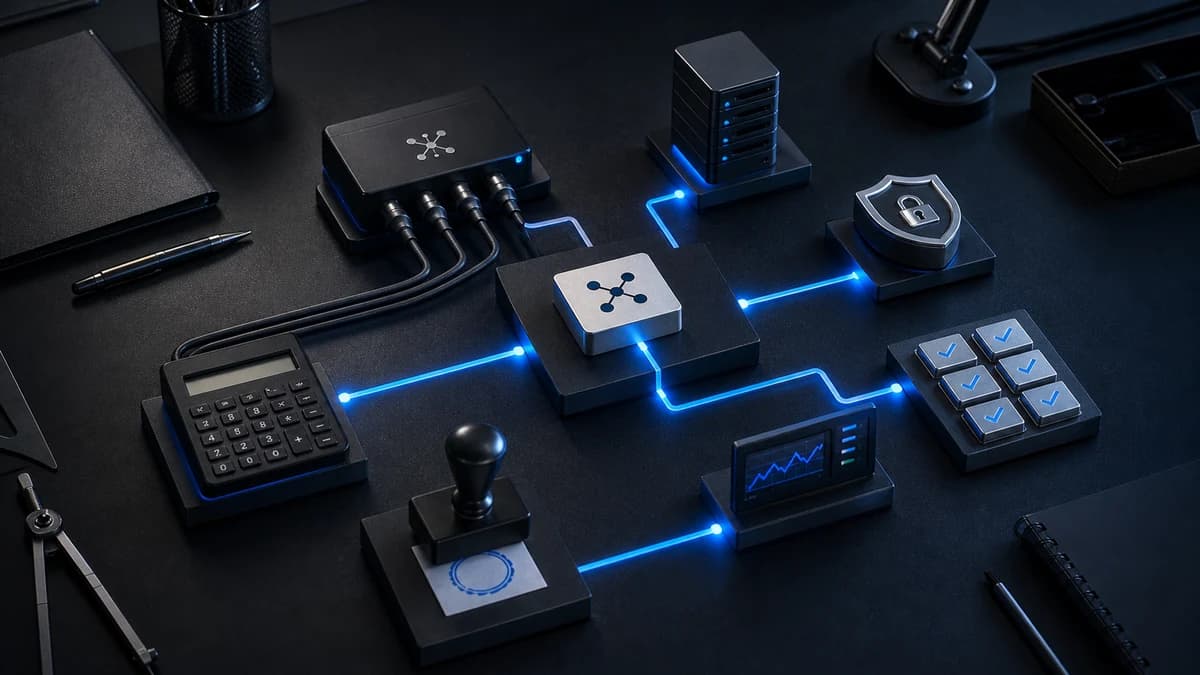
 Eight-dimension evidence system
Key Takeaway
An AI agent pilot is ready for production only when it can complete a bounded business workflow against representative cases, use the correct tools with the minimum permissions, stop or escalate safely, recover from failures, meet cost and latency limits, and leave enough evidence for an operator to understand what happened. Score the pilot across eight dimensions, but treat the hard-stop conditions as non-negotiable.
A polished demo can prove that an agent is interesting. It cannot prove that the agent is ready to handle live customers, operational records, money, approvals, or regulated information.
Production readiness is a business decision supported by technical evidence. The question is not simply, "Does the model give a good answer?" The useful question is:
Can this complete system produce the intended business outcome, within its authority, under normal and abnormal conditions, at an acceptable cost, while a named team can supervise and recover it?
That is a higher bar because an agent is more than a model response. It includes the prompt, model, tools, retrieval, memory, permissions, application code, human review, and operating process. Anthropic's current agent evaluation guidance makes the same distinction: the outcome is the final state in the environment, while the transcript is the record of how the agent got there.
This guide turns that distinction into a scorecard that product, operations, security, and engineering leaders can use before approving a production rollout.
The Production Readiness Decision in One Page
Score each dimension from 0 to 3 using recorded pilot evidence.
| Score | Meaning | Evidence standard |
|---|---|---|
| 0 | Unknown | The team has not defined or measured it |
| 1 | Demonstrated | It worked in a curated demo or a few happy-path examples |
| 2 | Piloted | It passed representative normal and exception cases in a controlled environment |
| 3 | Operational | It has a production target, monitoring, an owner, and a tested response when the target is missed |
Use the eight dimensions below for a maximum score of 24:
- Business outcome accuracy
- Representative case coverage
- Tool and integration correctness
- Permission and action boundaries
- Human control and escalation
- Failure handling and recovery
- Latency, throughput, and cost
- Observability and operating ownership
Recommended decision bands:
- 0 to 11: Do not launch. The pilot is still proving the concept or discovering the workflow.
- 12 to 17: Continue a controlled pilot. The system may run in shadow, draft, or internal-only mode while evidence gaps are closed.
- 18 to 21: Consider a limited production release. Restrict users, volume, tools, and autonomy. Monitor every run.
- 22 to 24: Evidence supports broader production use. Expansion should still be staged and reversible.
These bands are an original planning aid, not a universal standard. A high total never cancels a hard stop.
The seven hard stops
Do not approve production if any of these are true:
- No named business owner is accountable for the workflow outcome
- No representative evaluation set exists
- The agent can perform a high-impact action without appropriate approval
- Tool permissions are broader than the workflow requires
- A failed or duplicated write cannot be detected and recovered
- The team cannot trace which model, prompt, tools, and data produced an outcome
- There is no tested way to disable the agent or fall back to a safe process
NIST's AI Risk Management Framework Core calls for testing before deployment, regular measurement in operation, documented human oversight, and mechanisms to disengage systems whose behavior is inconsistent with their intended use. The hard stops above translate those ideas into a practical launch review.
1. Business Outcome Accuracy
Do not grade only the final message. Verify the state of the business process.
For a support agent, the outcome might be a correctly resolved ticket with the right disposition. For a revenue operations agent, it might be an accurate account update with supporting evidence. For a document workflow, it might be a complete structured record with every required field and citation.
Define three layers of acceptance:
- Task completion: Did the workflow reach the intended end state?
- Output quality: Is the result correct, complete, grounded, and usable?
- Process integrity: Did the system respect approvals, policy, and data boundaries while producing it?
A fluent answer that writes the wrong CRM record is a failure. A correct recommendation produced from prohibited data is also a failure.
Where possible, grade the outcome with deterministic checks: database state, schema validation, calculations, required fields, citations, or an existing business rule. Use model-based grading for qualities that cannot be reduced to code, and calibrate those graders against domain experts. Keep human review for consequential or genuinely subjective judgments.
Score 3 when: the pilot meets a written outcome target across representative cases, and the target maps to the real workflow rather than surface-level response quality.
2. Representative Case Coverage
An evaluation set should resemble the conditions the agent will meet after launch. It should not be a collection of prompts written only to make the system look competent.
Build the first set from five sources:
- Common historical cases from the real workflow
- High-cost or high-consequence cases
- Exceptions that currently require judgment or escalation
- Known failures from prototyping and user testing
- Adversarial or malformed inputs that probe the boundaries
OpenAI's evaluation workflow starts by describing intended behavior, testing it against inputs, and analyzing the results. Anthropic recommends unambiguous tasks, multiple trials for variable behavior, and graders that assess outcomes without requiring one brittle sequence of steps.
Do not chase a magic dataset size. Start with the cases your team already checks manually, then add failures as they appear. Separate:
- Capability cases, which test what the agent is learning to do
- Regression cases, which protect behaviors that must continue working
For nondeterministic tasks, repeat the same case more than once. A single pass can hide unstable behavior.
Score 3 when: normal, exception, boundary, and failure cases are versioned, repeatable, owned by the business and technical teams, and run before releases.
3. Tool and Integration Correctness
Tool use is where an impressive assistant becomes an operational system, and where small mistakes can change real records.
Evaluate each tool call at three levels:
- Selection: Did the agent choose the correct tool?
- Arguments: Were identifiers, amounts, dates, recipients, and other parameters correct?
- Result handling: Did it verify success, interpret the response correctly, and avoid claiming completion when the tool failed?
Test degraded conditions deliberately:
- Authentication expires
- An API times out
- A rate limit is reached
- The same event is delivered twice
- A record has changed since the agent read it
- A required field is missing
- A downstream system returns a partial success
The evaluation should check the actual downstream state, not the agent's narration. "The refund was issued" is not evidence that a refund record exists.
Score 3 when: every production tool has contract tests, safe retry behavior, duplicate protection where needed, verified outcomes, and a documented fallback.
4. Permission and Action Boundaries
Give the agent the smallest toolset and the narrowest permissions that can complete the approved workflow.
OWASP's Excessive Agency guidance recommends minimizing tool functionality and permissions, enforcing authorization in downstream systems, and requiring approval for high-impact actions. This matters because a prompt is not a security boundary.
Use an autonomy ladder:
- Observe: read approved information
- Draft: prepare an output without changing a system
- Recommend: propose an action and explain the evidence
- Act with approval: execute only after a person confirms
- Act within policy: perform a narrow, reversible action under enforced limits
Move upward only when the previous level has produced sufficient evidence. Do not give a mail-reading agent the ability to send or delete messages because the connector happens to support those methods.
For every action, document:
- Identity used to call the downstream system
- Resources and records it may access
- Read and write scopes
- Maximum amount, frequency, or batch size
- Required validation and approval
- Audit event and recovery path
Score 3 when: permissions are enforced outside the model, tested as the wrong user and with untrusted input, and reviewed whenever tools or workflow scope change.
5. Human Control and Escalation
Human review is not one generic confirmation button. Its location should follow consequence, uncertainty, and reversibility.
Define what happens when the agent:
- Lacks required information
- Encounters conflicting evidence
- Falls below a confidence or validation threshold
- Receives a request outside its scope
- Proposes a high-impact or irreversible action
- Exceeds time, token, step, or cost limits
The person reviewing the work needs enough context to make a real decision: the proposed action, source evidence, uncertainty, policy checks, and a clear approve, edit, reject, or escalate choice.
Also measure the review burden. An agent that sends nearly every case to a human may be safe, but it may not create the intended operational value.
Score 3 when: escalation rules are explicit, high-impact actions require proportionate approval, reviewers receive useful evidence, and review time is included in the operating model.
6. Failure Handling and Recovery
Production systems fail through dependency outages, malformed data, model behavior, timeouts, concurrency, and human error. Readiness means the failure is bounded and recoverable.
Run a failure drill for each critical dependency. Confirm that the system can:
- Stop before an unsafe action
- Mark the run as incomplete rather than falsely successful
- Preserve enough state to resume or replay safely
- Avoid duplicate writes
- Route the case to a person with the relevant evidence
- Fall back to a deterministic or manual process
- Roll back a reversible change
AWS's current Agentic AI Lens reliability guidance emphasizes predictable execution, automatic recovery, partial functionality under adverse conditions, and explicit fallback behavior. Those are operational requirements, not post-launch enhancements.
Score 3 when: critical failures have been injected and observed, recovery has been demonstrated, and the runbook names who acts and how service is restored.
7. Latency, Throughput, and Cost
Model accuracy does not rescue a workflow that is too slow or expensive to use.
Measure the unit that the business actually buys: one accepted workflow completion.
For each completion, capture:
- End-to-end duration
- Time spent in retrieval, model calls, tools, queues, and human review
- Model input and output tokens
- Tool and data-provider charges
- Retries and failed attempts
- Infrastructure and observability allocation
- Accepted, rejected, and escalated outcome
AWS's agent performance guidance groups success criteria into latency, throughput, quality, and efficiency. That is a better production view than tracking token cost in isolation.
Set targets before launch. Use percentiles for latency, not only averages, and test concurrent demand. Put hard limits on loops, tool calls, tokens, runtime, and spend. A workflow that costs less but creates more rework has not been optimized.
Score 3 when: the pilot meets written quality, latency, capacity, and cost-per-accepted-completion targets under a realistic traffic model.
8. Observability and Operating Ownership
If an operator cannot answer what happened, why it happened, and what changed, the system is not ready to own live work.
Each run should connect:
- User, tenant, trigger, and workflow version
- Model and configuration version
- Retrieved sources and applicable permissions
- Tool calls, parameters, responses, and timing
- Approval and policy decisions
- Final outcome and grader results
- Cost, latency, retries, and error state
Logs must respect privacy and retention rules. Observability does not mean storing every sensitive prompt forever.
Assign named ownership for:
- Business outcome
- Product behavior and evaluation set
- Security and permission review
- Infrastructure and incident response
- User escalation and feedback
- Model, prompt, tool, and data changes
NIST calls for ongoing monitoring, clear roles, user feedback, appeal or override mechanisms, incident response, recovery, and change management. The pilot should prove those operating capabilities before scale creates urgency.
Score 3 when: traces connect behavior to outcomes, thresholds create actionable alerts, changes are versioned, and a named team has exercised the incident and disable paths.
A 30-Day Evidence Plan
The exact timeline depends on access, risk, and workflow complexity. Use this sequence as a planning pattern, not a universal delivery promise.
Days 1 to 5: Define the contract
- Write the trigger, end state, users, systems, actions, exceptions, and owner
- Record the current baseline for time, quality, cost, volume, and rework
- Choose the initial autonomy level
- Define the hard stops and launch decision owner
Days 6 to 12: Build the evaluation set
- Collect normal, exception, consequential, malformed, and historical failure cases
- Define deterministic, model-based, and human graders
- Record expected outcomes and partial-credit rules
- Run repeated trials where outputs vary
Days 13 to 20: Exercise the system
- Test real integrations in a controlled environment
- Verify identities, scopes, arguments, and downstream outcomes
- Inject timeouts, duplicates, partial failures, and stale data
- Measure task completion, escalation, latency, and cost
Days 21 to 26: Run in shadow or draft mode
- Compare the agent with the current workflow without granting unnecessary write authority
- Review transcripts and failed cases with domain experts
- Add real failures to the regression suite
- Measure human review effort and adoption friction
Days 27 to 30: Make the decision
- Score all eight dimensions using linked evidence
- Apply every hard stop
- Document residual risks and accepted limitations
- Choose: stop, redesign, extend the pilot, launch narrowly, or expand
The decision package should contain the scorecard, evaluation results, permission map, failure drill, operating targets, residual risks, owner, and rollback plan.
Example: An Invoice Exception Agent
Imagine an agent that reviews invoice exceptions, retrieves purchase-order context, proposes a resolution, and updates the finance system after approval.
The demo works on five clean invoices. Production readiness requires much more:
- Outcome checks confirm the exception category, amount, supplier, and system state
- Cases include duplicate invoices, missing purchase orders, tax mismatches, conflicting records, and restricted suppliers
- The agent can read only the necessary records and cannot release payment
- Updates require finance approval above a defined consequence threshold
- Duplicate delivery does not create duplicate notes or actions
- An unavailable finance API produces a visible incomplete state and a safe retry
- Cost and completion time are measured per accepted exception
- Every run is traceable to the evidence, action, approver, and final record
That system may deserve a limited launch. The original five-case demo does not.
What to Ask a Vendor Before Approving Production
Ask for artifacts, not assurances:
- Show the representative evaluation set and the latest results.
- Show how final business outcomes are verified.
- Show the exact tools and permissions available to the agent.
- Show where authorization is enforced outside the model.
- Show a high-impact action being routed for approval.
- Show a timeout, duplicate event, and failed downstream write.
- Show how a run is traced across retrieval, model calls, and tools.
- Show latency and cost per accepted completion under realistic load.
- Show who owns incidents, evaluation maintenance, and user escalation.
- Show how the agent is disabled, rolled back, or returned to manual operation.
If the answer is another demo, the evidence is incomplete.
The Bottom Line
An AI agent earns production access by proving a bounded operating capability. It must complete the right outcome, on representative work, through correct and authorized actions, with safe escalation, recoverable failures, acceptable economics, and accountable ownership.
The score is useful because it exposes weak dimensions. The hard stops are more important because they prevent a polished average from hiding a dangerous gap.
If your team has a promising agent pilot but no defensible launch decision, send ZamDev AI the workflow and current evidence. We can turn it into a production readiness review, evaluation plan, permission boundary, and staged release decision. You can also start with our AI Opportunity and Workflow Blueprint or review the AI agent development service.
Evidence and scope
What this guide is based on
The scorecard and decision bands are an original planning framework informed by current primary-source guidance. They are not a universal standard, compliance certification, legal opinion, or guarantee that a system is safe. Thresholds and evidence depth must follow the workflow's real consequence and the organization's risk tolerance.
Intended for: CTOs, operations leaders, product owners, security teams, and founders deciding whether an AI agent pilot should receive production access.
Frequently Asked Questions
How do you evaluate an AI agent before production?+
What metrics matter for an AI agent pilot?+
How many test cases does an AI agent need?+
When should an AI agent require human approval?+
What is the difference between a successful pilot and a production-ready agent?+
Related Articles


Written by
Zamad Shakeel
Founder & CEO, ZamDev AI · Full-Stack Engineer & AI Systems Builder
Zamad designs and ships AI products, agentic workflows, enterprise automations, and the production controls that make those systems dependable after launch.
linkedin.com/in/zamad-gopang →Turn the decision into a working system.
ZamDev AI helps teams design and deliver AI products, connected automations, knowledge systems, and production improvements with a clear scope and measurable acceptance criteria.
Or WhatsApp us directly: +92 328 635 6880